

A teenager in Bangalore doesn’t search “best fitness app”, she opens Gemini and asks. A business owner in Delhi opens ChatGPT, asks which CRM to use, and gets 3–4 recommended answers instead of ten blue links to explore.
None of them scrolled past the AI’s response. None of them went to page two. They just moved on, with a decision already made.
This is not a trend to prepare for. It’s the current reality for businesses across India, and most brands haven’t noticed yet because the losses don’t show up anywhere in their analytics.
The Search Game Has Changed, And Nobody Sent a Memo
Two years ago, search was democratic in a useful way. A startup founder looking for project management software would Google it, see ten organic results, click through a few, compare options. If you ranked eighth, you still had a shot. The user could find you, evaluate you, pick you.
AI search doesn’t work like that.
When someone asks ChatGPT “best project management tool for a small team,” they get one synthesized answer, typically naming two or three options with reasoning. If you’re not in that answer, you simply don’t exist for that user. There’s no page two. There’s no “let me keep scrolling.” The conversation moves on without you.
And this isn’t a niche behavior. According to a recent Zaillor analysis of AI search trends in India, high-intent queries, the kind where people are ready to buy, subscribe, or hire, are increasingly starting in AI chatbots rather than Google. The users asking these questions are the ones businesses want most, and they’re the ones disappearing from traditional analytics.
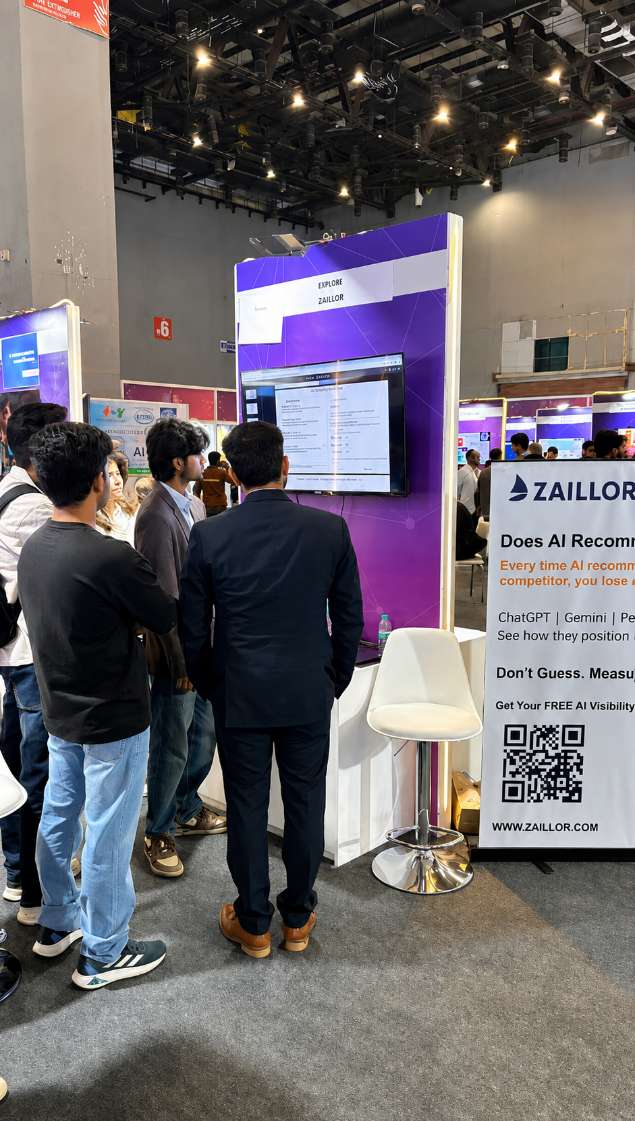
Fig; Zaillor team guiding Indian business owners with their AI visibility at the AI Impact Summit 2026 held at Bharat Mandapam, New Delhi
Why Your SEO Playbook Doesn’t Work Here
This is where most brands make a critical mistake: they assume their Google ranking translates to AI visibility. It doesn’t.
Google ranks you based on keywords, backlinks, domain authority, and technical SEO signals. AI recommends brands based on an entirely different set of criteria:
Citation credibility, have reputable publications, industry media, and trusted sources written about you? Content accuracy, is your publicly available information correct, comprehensive, and well-structured? Source authority, does AI consistently encounter your brand in contexts it considers reliable? Contextual relevance, are you associated with the specific problem the user is asking about?
A brand could rank number one on Google for every keyword in its category and still be completely invisible to ChatGPT. The two systems are measuring fundamentally different things.
You can’t stuff keywords into AI visibility. You can’t buy backlinks your way into a ChatGPT recommendation. AI looks at who credible sources say is worth mentioning, and finds you (or doesn’t) based on that.
The Brands Getting Hit Hardest
Established players have an inherent advantage. They’ve been written about for years, in trade publications, analyst reports, mainstream media. AI has encountered their names in credible contexts thousands of times. It trusts them by default.
For India’s startup ecosystem, the SaaS companies, D2C brands, fintech players, and service providers building genuinely better products, this is a structural problem. Limited press coverage, thin citation history, and fewer mentions in the places AI looks means they’re systematically invisible, regardless of product quality.
A Zaillor study on AI visibility across Indian SaaS brands found that many startups with strong Google rankings had near-zero presence in AI-generated recommendations, not because their products were weak, but because they lacked the citation infrastructure AI relies on.
The Losses You Can’t See Are the Most Dangerous
In the Google era, losing visibility was at least visible. You could see competitors ranked above you. You could track impression drops. You had data to work with.
With AI, the loss is completely silent. A potential customer asks Gemini which lending app works best for freelancers. Your competitor gets named. You don’t. The customer never finds you. You see no lost impression, no bounce, no missed click, just slightly slower growth you can’t quite explain.
Multiply that across ChatGPT, Gemini, and Google AI. Across dozens of queries a day in your category. That’s not a rounding error, it’s a revenue leak. It’s the gap between the growth you expected and the growth you got, and you have zero visibility into why.
Why This Is Urgent Right Now
This isn’t a problem that waits politely while you figure out your strategy.
AI search adoption in India has crossed the tipping point. The users asking AI are typically high-intent, they’re not browsing, they’re buying. And AI systems build trust in brands over time, which means visibility compounds. The brands establishing presence now will be disproportionately hard to displace in twelve months.
There’s a competitive window open today that won’t stay open. Early movers who invest in AI visibility now will own category mindshare in AI-generated answers. Late movers will be stuck competing on price and paid ads, the most expensive and least defensible position in any market.
For Indian businesses specifically, this is the next frontier after the Google ranking race, and the cost of sitting it out is far higher, because you won’t even know what you’re losing.
The Starting Point: Know Where You Stand
Before strategy comes measurement. Most businesses have no idea how AI is describing them, or whether it describes them at all.
The questions that matter: How often does AI mention your brand when someone asks a question in your category? Are the facts it states about you accurate, pricing, features, positioning? How do you compare to competitors in AI visibility? And what’s creating the gap, a credibility problem, a citation problem, or a content problem?
Without that baseline, any effort is guesswork. With it, you can act strategically, building citation presence where it’s missing, correcting inaccurate information where it exists, and positioning your brand in the contexts AI actually draws from.
Frequently Asked Questions
What is AI visibility, and how is it different from SEO? SEO focuses on ranking your website on Google through keywords, backlinks, and technical optimization. AI visibility is about whether platforms like ChatGPT, Gemini, and Google AI mention and recommend your brand when users ask questions in your category. A brand can rank number one on Google and still be completely absent from AI-generated answers. The two require fundamentally different strategies.
Can I check if AI is mentioning my brand? Yes. You can manually test by asking ChatGPT, Gemini, or Google AI category-level questions relevant to your business and seeing if your brand appears. However, manual checks are inconsistent and don’t scale. Tools like Zaillor’s AI Visibility Score automates this, tracking your mention rate, accuracy, and competitive standing across all major AI platforms.
Does AI visibility matter if my business is small or local? Absolutely. AI doesn’t filter by company size, it filters by credibility and relevance. A local accounting firm, a niche D2C brand, or a 10-person SaaS startup can all appear in AI recommendations if their information is accurate, well-cited, and present in sources AI trusts. In fact, smaller businesses often have the most to gain because a single AI mention can drive high-intent customers directly to them.
How long does it take to improve AI visibility? There’s no overnight fix. AI systems build trust over time based on consistent, credible citations across authoritative sources. Most businesses start seeing measurable changes within 8 to 12 weeks of structured effort, but the compounding effect means the earlier you start, the harder it becomes for competitors to catch up.
About Zaillor
Zaillor is an AI Visibility Optimization company. Zaillor measures how AI platforms including ChatGPT, Gemini, and Claude currently describe and surface a brand, identifies the structural gaps that limit discoverability, and implements the content, technical, and semantic changes needed to improve AI citation and recommendation across platforms. Zaillor helps brands become more visible and get recommended by AI platforms like ChatGPT, Gemini, and Claude.
Website: www.zaillor.com
Media Contact Zaillor Communications For press enquiries, report access, data requests, or interview scheduling: support@zaillor.com | +91 9560205528
