

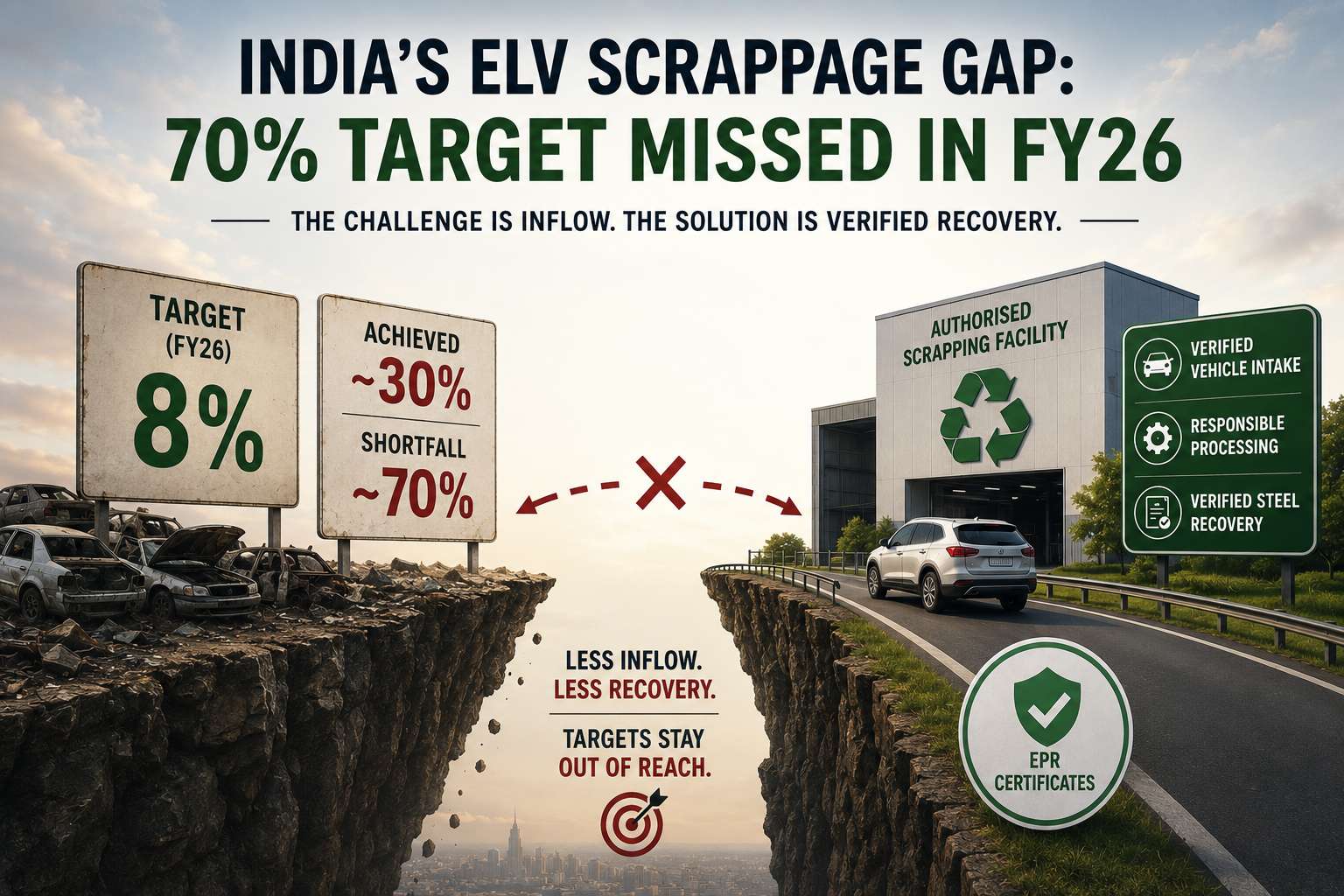
India’s first year of mandatory vehicle recycling obligations has closed with a compliance gap the automotive sector cannot look past. In a Press Trust of India (PTI) report carried by Business Standard in May 2026, industry executives citing official data said the sector fell short of its FY26 steel-recovery obligations by roughly 70 percent.
The figures point to a structural mismatch between what the Environment Protection (End-of-Life Vehicles) Rules, 2025 require and how many end-of-life vehicles are actually reaching authorized facilities.
Why the Sector Fell 70 Percent Short
The Rules were notified by the Ministry of Environment, Forest and Climate Change (MoEFCC) vide S.O. 98(E) on 6 January 2025 and took effect on 1 April 2025. As confirmed in a Government of India reply in Parliament, they place mandatory Extended Producer Responsibility (EPR) targets on vehicle producers, requiring recovery of a set weight of steel from scrapped vehicles against a historical sales baseline.
Under the Schedule to the Rules, the FY26 obligation is:
- 8 percent of the steel equivalent of qualifying vehicles
- a 20-year sales baseline for private (non-transport) vehicles
- a 15-year sales baseline for commercial (transport) vehicles
The volumes explain the miss. According to the same PTI report, which was also carried by Outlook Business and The Tribune, only about 2.42 lakh vehicles reached registered scrapping centres in FY26, a shortfall of roughly 5.2 lakh, or close to 70 percent of the requirement. With so little material entering the formal channel, the target was out of reach at sector scale.
The bar then rose mid-cycle. A draft amendment issued by the MoEFCC on 27 March 2026, still at the draft stage, removed the provision that allowed “other steel scrap materials” to count toward EPR certificate generation. Only steel recovered directly from scrapped vehicles now qualifies.
Most producers had planned FY26 around a mix of vehicle scrappage and qualifying industrial steel scrap. Removing the second route concentrated the full obligation onto a thin vehicle-inflow pipeline. As of January 2025, the Government reported just 84 operational Registered Vehicle Scrapping Facilities (RVSFs) nationwide, an ecosystem still scaling toward the sector’s needs.
Meta Materials Circular Markets (MMCM), an Indian envirotech company focused on the end-of-life vehicle sector, works in this part of the pipeline, building the digital systems registered facilities use to process and document scrapped vehicles.
The Cost of the Miss and the Industry’s Response
The shortfall carries a balance sheet consequence. The Society of Indian Automobile Manufacturers (SIAM) has estimated a one-time gross impact of around Rs 25,000 crore for FY2025-26, with a lower figure on a discounted basis, driven by provisioning against past sales under accounting standard Ind AS 37.
Unmet obligations also attract Environmental Compensation under the Rules, a charge designed to exceed the cost of compliance itself. Non-compliance further feeds into Business Responsibility and Sustainability Reporting (BRSR) disclosures mandated by SEBI, and into investor-facing ESG assessments.
SIAM has written to the ministry seeking a phased transition rather than an exemption. As reported by Auto Recycling World in May 2026, its submission flags that:
- automated testing stations are so far generating negligible ELV volumes
- other automotive steel scrap should be permitted in the initial years, until the recycling ecosystem matures
The sequencing matters because the targets, as set in the Schedule to the Rules, do not stay at 8 percent:
- 8 percent from FY26 to FY30
- 13 percent from FY31 to FY35
- 18 percent from FY36 onward
An inflow gap left unaddressed now compounds with every five-year step, widening the shortfall rather than closing it.
The Fix Is Verified Vehicle Inflow
The gap is a supply gap, not a paperwork one. A producer can only buy an EPR certificate after an RVSF has scrapped a vehicle and logged the recovered steel on the Central Pollution Control Board (CPCB) portal, which issues one kilogram of certificate per kilogram of steel. Vehicles left with informal dismantlers generate nothing.
MMCM works on that supply side through AutoLoop, the system RVSFs use to log vehicle intake, run VAHAN checks, and record depollution, dismantling and steel recovery against a 41-point digital Measurement, Reporting and Verification (dMRV) framework aligned with AIS-129. MMCM does not scrap or recycle vehicles; it captures the recovery data a valid certificate depends on.
The lesson from FY26 is direct: until more end-of-life vehicles reach registered facilities, the targets stay out of reach. Producers that source certificates year-round, straight from RVSFs, are the ones positioned to close the gap.
